


Table of Contents
- What Makes Made to Order Fashion Different?
- The Environmental Benefits of On-Demand Production
- Made-to-Order vs Fast Fashion: Key Differences
- Is Made to Order Fashion More Expensive?
- The Benefits of Slow Fashion for Your Wardrobe
- How to Identify Sustainable Clothing Brands
- The Hidden Cost of Returns in Fashion
- Conclusion: Is It Worth the Wait?
- Frequently Asked Questions
Last Updated: September 9, 2026
What Makes Made to Order Fashion Different?
Made to order fashion is a production model where garments are created only after a customer places an order, rather than being manufactured in bulk and stored in warehouses. This stands in direct opposition to the traditional retail cycle, which relies on predicting demand months in advance. At F'cks Given Full Heart Co., we build our entire collection around this principle, creating each piece only when someone like you chooses it.
The difference feels tangible when you receive the product. A made to order garment isn't sitting in a distribution center for six months; it's produced fresh, often within days of your purchase. This eliminates the massive inventory surplus that plagues conventional retailers, where unsold stock becomes deadstock and eventually ends up in landfills.
For the conscious consumer, this model offers something rare: alignment between what you buy and what you believe. You're not just purchasing a shirt. You're opting out of a system built on overproduction and waste. The trade-off is patience, and that's a trade worth examining closely.
The Environmental Benefits of On-Demand Production
On-demand manufacturing addresses the root cause of fashion's environmental crisis: producing goods nobody has confirmed they want yet. When production is tied directly to consumer demand, the entire supply chain shrinks in impact, fewer raw materials are extracted, less energy is consumed, and fewer garments travel through logistics networks without a destination.
This model naturally supports a circular economy by keeping products in use longer and reducing the flow of new items entering the market. The Ellen MacArthur Foundation's work on the circular economy highlights how shifting from linear take-make-dispose systems to circular ones is essential for the industry's future. Made to order is one of the most direct ways brands can participate in this shift without compromising on quality.
How On-Demand Manufacturing Cuts Textile Waste
Textile waste is one of the most visible consequences of fast fashion. When brands overproduce, unsold inventory is often shredded, incinerated, or shipped to developing nations where it overwhelms local waste systems.
Made to order sidesteps this entirely. Since each garment has a confirmed owner before production begins, there is no surplus to discard. The environmental impact of this difference is substantial, though precise figures vary by brand and material. What remains clear is that producing one garment for one person generates far less waste than producing ten garments hoping one sells.
Made-to-Order vs Fast Fashion: Key Differences
The gap between made-to-order and fast fashion isn't just about production speed, it represents two completely different philosophies about consumption, value, and the relationship between buyer and maker.
Fast fashion operates on volume and velocity: new styles drop weekly, prices are kept artificially low, and garments are designed with planned obsolescence in mind. Made to order inverts this logic entirely, production is slower, prices reflect true cost, and garments are designed for longevity rather than disposability.
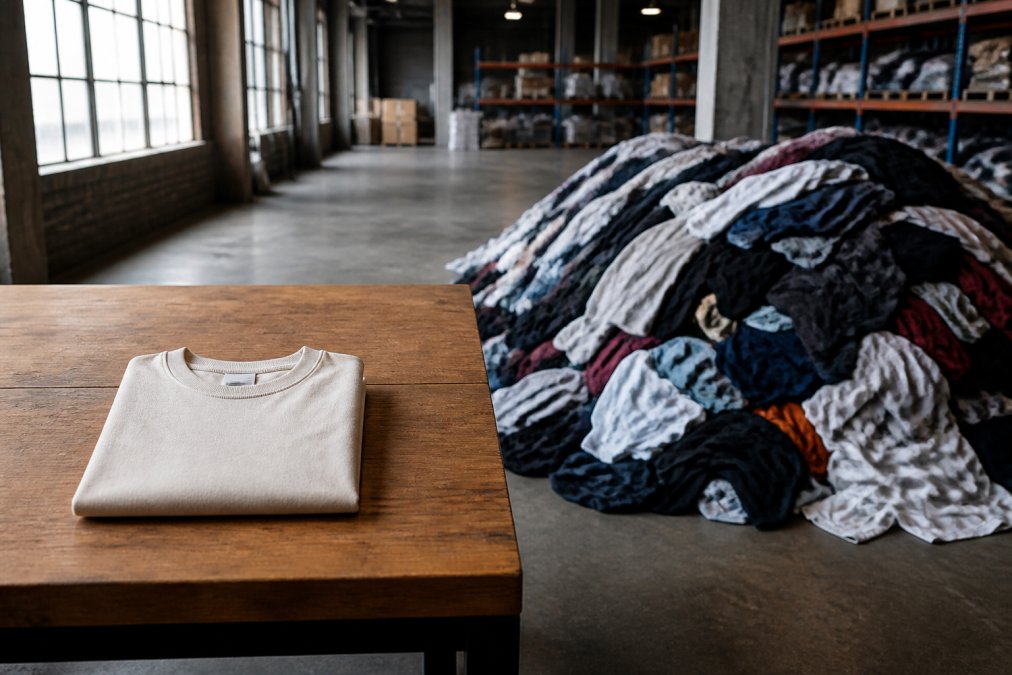
The consumer habits each model encourages are equally divergent. Fast fashion trains shoppers to treat clothing as disposable, while made to order encourages thoughtful purchasing decisions, when you wait for a garment, you value it more.
| Factor | Made to Order | Fast Fashion |
|---|---|---|
| Production trigger | Customer order | Demand forecast |
| Inventory risk | Near zero | High overproduction |
| Garment lifespan | Designed for years | Designed for seasons |
| Environmental cost | Production only | Production plus waste |
| Consumer mindset | Intentional | Impulsive |
Is Made to Order Fashion More Expensive?
Yes, made to order fashion typically costs more upfront than fast fashion, but the economics look different when you factor in longevity. A $30 made to order tank top that lasts five years outperforms five $15 fast fashion tees that pill, fade, and stretch after a few washes.
The price difference reflects real costs: ethical manufacturing pays workers fairly, sustainable materials cost more than conventional synthetics, and smaller production runs don't benefit from the same economies of scale. These costs are baked into the price tag because someone is actually bearing them, with fast fashion, those costs are externalized onto workers and the environment.
At F'cks Given Full Heart Co., our Women's Racerback Tank - I Am Enough is priced at $23.40, while our Women's Triblend Dolman Tee - Unapologetically Me runs $30.94. These prices reflect 100% combed ring-spun cotton, ethical production, and a garment designed to become a staple, not a disposable trend piece.


The Benefits of Slow Fashion for Your Wardrobe
Shifting to slow fashion transforms your wardrobe from disposable trends into a curated set of pieces that reflect who you are. This is where made to order fashion becomes deeply personal, each garment carries intention, both from the designer and from you for choosing it.
A slow fashion wardrobe solves the daily "nothing to wear" problem, when every piece was selected deliberately, everything coordinates, and quality fabrics hold their shape and color. Wearing a piece that aligns with your values, like our Women's Slouchy Off-Shoulder Tee - Breathe In and Let It Out at $34.30, becomes a daily reminder of your commitment to yourself.

Garment longevity is the quiet superpower of slow fashion. Well-made natural fibers can last decades with proper care, and that single purchase replaces dozens of fast fashion items over its lifetime.
How to Identify Sustainable Clothing Brands
Identifying genuinely sustainable clothing brands requires moving beyond marketing language and into verifiable operational details. Sustainability isn't a vibe; it's a set of measurable practices. The Federal Trade Commission's Green Guides provide a useful framework for understanding what environmental claims actually mean and how they should be substantiated. But to truly evaluate a made-to-order brand, you need to ask questions that get at the specifics of their supply chain.
The challenge is that 'made to order' is a production model, not a sustainability certification. A brand can use on-demand printing while still relying on a supply chain with opaque labor practices. To separate genuine leaders from those using the term as a buzzword, look for supply chain transparency metrics, concrete, verifiable data points that substantiate claims.
Here is a practical checklist for evaluating a brand's claims:
- Material Provenance: Does the brand name the specific mill or farm where the fiber was sourced? For example, a claim of 'organic cotton' is stronger when paired with a certification from a body like the Global Organic Textile Standard (GOTS). A claim of 'recycled polyester' is stronger when the brand identifies the supplier of the recycled content.
- Factory Disclosure: Does the brand name the specific factory or partner where the garment is cut and sewn? Public disclosure of factory lists is a hallmark of transparency. If a brand only says 'we partner with ethical factories in [region]' without naming them, it is a red flag.
- Production Lead Time: A genuine made-to-order brand will be transparent about its production time. A standard lead time of one to two weeks is common for a single garment. If a 'made to order' brand ships in 24 hours, they are almost certainly holding inventory and using the term as a marketing label.
- Third-Party Certifications: Look for certifications that audit the entire supply chain, not just the final product. B Corp certification assesses a company's entire social and environmental performance. Fair Trade Certified™ ensures fair wages and safe working conditions for farmers and workers. These are more robust than a brand's self-authored 'sustainability page.'
- Data on Waste: Does the brand publish data on its own waste or return rates? While not yet standard practice, leading brands are beginning to share these metrics. A brand that openly discusses its challenges and targets for waste reduction is more credible than one that only shares aspirational statements.
The Sustainable Apparel Coalition's Higg Index is a standardized measurement tool that many brands use to assess their supply chain impact. While not a consumer-facing label, you can often find references to it in a brand's sustainability report, which signals a commitment to standardized, third-party-verified data.
Red Flags to Watch For
Certain patterns should raise immediate suspicion. Brands that release new collections weekly while claiming sustainability are contradicting themselves, and vague claims without specific data signal marketing over substance.
Another red flag is the absence of information about what happens to unsold inventory, how a brand handles surplus reveals its true priorities. The most reliable signal is a brand that openly discusses production lead times, names its factories, and points to third-party certifications.
The Hidden Cost of Returns in Fashion
The fashion industry's returns problem is a logistical and environmental blind spot. While production waste gets headlines, the reverse logistics of returns carries its own significant carbon footprint, transportation, processing, repackaging, and potential disposal can negate a significant portion of the environmental savings from a single production run.
Made-to-order fashion structurally mitigates this issue, but not automatically. The model eliminates the 'buy multiple sizes to try at home' behavior that drives return rates, but the true environmental benefit is only realized if the brand also invests in fit-accuracy tools. A made-to-order garment that doesn't fit is a worst-case scenario: it has consumed resources for a unique production run, only to be returned and likely written off as a loss.
Leading brands in this space are moving beyond simple size charts. They are adopting:
- AI-Powered Size Recommendations: Tools that use a customer's height, weight, and fit preferences to predict the correct size, reducing the guesswork that leads to returns.
- Detailed Garment Measurements: Providing precise, garment-specific measurements (e.g., pit-to-pit, shoulder-to-shoulder) in inches and centimeters, rather than relying on vague S/M/L labels.
- Customer Fit Profiles: Storing a customer's measurements and past purchase feedback to refine recommendations on future orders.
The consumer also plays a role. You can further reduce your own impact by:
- Measuring a well-fitting garment you already own and comparing it to the brand's size chart.
- Reading fabric composition and stretch characteristics. A 100% cotton woven shirt will fit differently than a cotton-spandex knit.
- Contacting the brand's customer service with fit questions before ordering. A brand committed to sustainability will have staff who can provide guidance to prevent a costly and wasteful return.
For the conscious consumer, the 'wait time' is not just a production lead time; it's also a decision-making period. Using that time to verify your measurements is the single most effective way to ensure your purchase doesn't become part of the returns problem it is meant to solve.
Conclusion: Is It Worth the Wait?
The answer depends on what you value. If your priority is instant gratification and rock-bottom prices, made to order fashion will frustrate you. But if you're seeking clothing that aligns with your ethics and lasts for years, the wait is part of the value.
Made to order fashion is sustainable because it fundamentally restructures the relationship between production and consumption, eliminating overproduction, reducing textile waste, lowering return rates, and encouraging more thoughtful purchasing habits. These aren't marketing claims; they're structural outcomes of the model itself.
For those ready to embrace this approach, the Unisex Triblend Racerback Tank - As Above, As in My Heart, As in My Soul from F'cks Given Full Heart Co. represents what conscious consumption looks like in practice: sustainably produced, intentionally designed, and built to last. The United Nations Alliance for Sustainable Fashion continues to highlight how production model shifts like this are essential for the industry's environmental future.
Frequently Asked Questions
What are the primary environmental benefits of made-to-order clothing?
The main benefits are waste reduction and resource efficiency. By producing items only after an order is placed, brands avoid overproduction and the creation of deadstock that often ends up in landfills. This method also reduces the carbon footprint associated with storing and discounting unsold inventory, making it a core part of the slow fashion movement.
Is made-to-order fashion more expensive than mass-produced clothing?
Often, yes. Because you are paying for the materials, labor, and time for a single item rather than a batch of thousands, the cost per piece is higher. However, this price often reflects better ethical labor practices and higher-quality materials. You are investing in garment longevity rather than the fast fashion cycle of frequent, low-quality replacements.
How can consumers identify truly sustainable made-to-order brands?
Look for supply chain transparency. A genuine brand will share details about where and how their clothes are made, including factory locations and material sourcing. They will also be clear about their lead times and return policies for custom items. Be wary of brands using vague terms like 'eco-conscious' without providing specific sustainability metrics or certifications.
Does made-to-order production eliminate the need for seasonal sales?
Yes, for the most part. Since brands are not holding large amounts of retail inventory, they do not need to clear out unsold stock at the end of a season. This pre-order model helps stabilize pricing and reduces manufacturing waste, allowing brands to focus on creating timeless, bespoke pieces rather than chasing trends that may not sell.
The fashion industry's waste problem won't solve itself through consumer guilt or recycling programs alone. It requires structural change in how clothes are made. Made to order fashion delivers that change, one intentional garment at a time. At F'cks Given Full Heart Co., every piece we create is made to order, consciously designed, and created to support your authentic self-expression. SHOP NOW → and experience the difference of clothing made with intention.

