


Table of Contents
- What Intentional Apparel Means (And Why It's Not Just Another Trend)
- The Psychological Benefits of Dressing Well: Enclothed Cognition Explained
- How Intentional Apparel Boosts Confidence, Self-Respect, and Mental Health
- The Benefits of Ergonomic Smart Workwear for Office Employees
- How to Build a Capsule Wardrobe for Beginners: A Step-by-Step Wardrobe Audit
- Intentional Apparel vs. Fast Fashion: Environmental, Economic, and Social Impact
- Common Mistakes to Avoid When Building an Intentional Wardrobe
- Frequently Asked Questions
Last Updated: September 14, 2026
What Intentional Apparel Means (And Why It's Not Just Another Trend)
Intentional apparel is clothing chosen on purpose: for how it fits, how it's made, how long it lasts, and what it says about who you are. It's the opposite of grabbing whatever's on the sale rack because it's cheap and available.
This guide from F'cks Given Full Heart Co. covers the real benefits of wearing intentional apparel, from sharper thinking to a smaller environmental footprint. The psychology behind it is well documented. The practical side, the actual building of a wardrobe, is where most people get stuck. Below, we'll walk through both.
The core idea is simple: every item you own should earn its place. If it doesn't fit well, serve a purpose, or feel like you, it's taking up space that something better could fill. That's not minimalism for its own sake. It's editing.
The Psychological Benefits of Dressing Well: Enclothed Cognition Explained
Enclothed cognition is the psychological principle that what you wear directly influences how you think, feel, and perform. The term describes how clothing carries symbolic meaning, and wearing it shifts your mental state accordingly.
The theory gained traction after researchers demonstrated that participants wearing a lab coat performed better on attention tasks, but only when told the coat belonged to a doctor. Same garment, different meaning, different result. That finding matters because it suggests the power isn't in the fabric. It's in what the garment represents to you.
This is where intentional apparel separates itself from ordinary shopping. When you choose a piece because it reflects a value you hold, you're not just covering your body. You're reinforcing an identity every time you put it on.
How Intentional Apparel Boosts Confidence, Self-Respect, and Mental Health
The confidence boost from intentional dressing isn't vanity. It's self-respect made visible. Getting dressed with care signals to yourself that you matter, and that internal message compounds over time.
Many therapists and mental health practitioners note that appearance management can be a grounding routine during difficult periods. The act of choosing an outfit becomes a small daily decision that reinforces agency. It's not a cure for anything, but it's a practical anchor.
There's a social layer too. People read clothing as visual communication before a word is spoken. Intentional choices shape that first impression deliberately rather than leaving it to chance. That's person perception at work, and it cuts both ways: how others see you, and how you see yourself reflected back.
The Benefits of Ergonomic Smart Workwear for Office Employees
Ergonomic smart workwear is professional clothing designed around how the body actually moves during a workday: stretch fabrics, breathable weaves, and cuts that don't restrict range of motion. The benefits of ergonomic smart workwear for office employees come down to two things: physical comfort and sustained focus.
A stiff blazer that pinches at the shoulders pulls attention away from your work all day. Soft, well-cut pieces remove that background friction. When clothing isn't demanding your attention, you have more of it for the task in front of you.
The professional angle matters too. Smart workwear keeps you presentation-ready for video calls and in-person meetings without the discomfort of traditional corporate tailoring. You look composed and you feel unconstrained, which is a combination most office dress codes ignore entirely.
How to Build a Capsule Wardrobe for Beginners: A Step-by-Step Wardrobe Audit
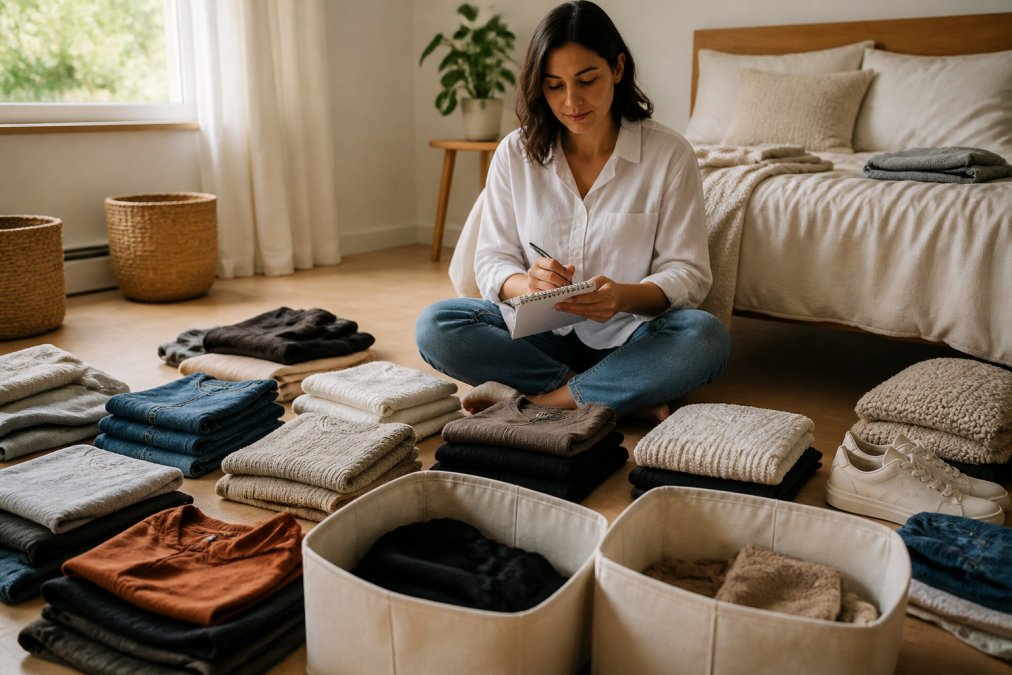
A capsule wardrobe is a small, curated collection of versatile pieces that mix and match to cover most occasions. Most guides stop at "buy less, choose well." That's a slogan, not a system. Here's the actual mechanics.
The audit: what you own right now
- Empty the closet completely. Pile everything on the bed. You need to see the full inventory before you can judge it.
- Sort into four piles: keep, repair, donate, discard. Be honest. If you haven't worn it in a year, it goes.
- Ask three questions of every "keep" item. Does it fit right now? Does it suit your actual life? Does it feel like you?
- Count your staples. Tally what you actually kept by category: tops, bottoms, layers, shoes, accessories.
- Identify the gaps. Write down what's missing before you buy anything. This list prevents impulse purchases.
- Buy slowly and on purpose. Replace gaps one piece at a time, choosing quality over quantity.
The audit usually takes an afternoon. The discipline it builds lasts much longer.
| Audit Stage | What You're Doing | Time Needed |
|---|---|---|
| Empty and sort | Full closet inventory | 1-2 hours |
| Evaluate | Fit, lifestyle, identity check | 30-45 minutes |
| Gap list | Identify what's missing | 15 minutes |
| Rebuild | Slow, intentional purchases | Ongoing |
The mechanics: how a capsule actually functions
A capsule isn't just a small closet. It's a small closet engineered so that every piece works with most of the others. Three rules do most of the work.
Rule 1: Anchor on two or three base colors. Pick a neutral core, for example, black, navy, and a warm neutral like cream or camel, and build the majority of your pieces inside that palette. Base colors are what let a top from one outfit pair with a bottom from another. Without an anchor palette, a capsule collapses into a pile of orphans.
Rule 2: Keep a base-to-accent ratio. A workable starting ratio is roughly 70% base pieces (neutrals, solids, simple cuts) and 30% accent pieces (a print, a bold color, a statement layer). The base carries the versatility; the accents carry the personality. Flip the ratio and you get a closet that's interesting but unwearable.
Rule 3: Target a piece count that matches your life. There's no universal number, but a common starting range for a beginner capsule is roughly 25 to 35 pieces total, excluding underwear, sleepwear, and activewear. That range covers most people who dress for a mix of work, casual, and occasional events. If you dress formally five days a week, you'll sit at the higher end. If you work from home, you can run leaner.
Handling the variables most guides skip
Seasons. A single capsule can't cover a Midwest winter and a Gulf Coast summer. The practical fix is a core capsule that stays year-round (base tops, pants, one versatile layer) plus a seasonal add-on of roughly 8 to 12 pieces that rotates in and out. Store the off-season pieces out of sight so they don't crowd your daily choices.
Dress codes. If your week spans a casual office, client meetings, and weekend errands, your capsule needs at least one piece that bridges two contexts. A structured blazer over a plain tee reads professional; the same tee with jeans reads casual. Bridge pieces earn their place because they multiply the outfits every other piece can form.
Laundry reality. A capsule assumes you can wear pieces more than once between washes. If your lifestyle or climate doesn't allow that, size up the capsule rather than fighting the math.
The gap list: what to buy and in what order
Once the audit is done, rank your gaps by how many outfits each new piece would unlock. A neutral bottom that pairs with six existing tops beats a statement jacket that pairs with one. Buy in that order. It's the difference between a capsule that grows more useful with each purchase and one that grows more cluttered.
Intentional Apparel vs. Fast Fashion: Environmental, Economic, and Social Impact
Fast fashion runs on volume and speed. Intentional apparel runs on longevity and mindful consumption. The gap between them shows up in three places: your wallet, the environment, and the people making the clothes.
The economics: cost-per-wear math
The cheap shirt isn't cheap. It's replaced three or four times over a few years, and the cost adds up fast. The honest way to compare two garments is cost per wear, not sticker price.
The formula is simple: purchase price divided by the number of times you actually wear it.
| Garment | Price | Wears before replacement | Cost per wear |
|---|---|---|---|
| Fast-fashion tee | $12 | ~15 wears, then it pills or stretches out | ~$0.80 |
| Well-made tee | $45 | ~150 wears with proper care | ~$0.30 |
The fast-fashion tee looks cheaper at the register. It isn't cheaper across a year. And that math doesn't even count the time you spend replacing it, the gas you burn driving to the store, or the mental load of a closet full of things that never quite fit.
There's a second economic layer most shoppers never consider: resale value. Quality garments from recognizable makers hold a meaningful fraction of their purchase price on resale platforms. Fast-fashion pieces typically resell for a small fraction of retail, if they sell at all. A wardrobe of pieces with resale value is a wardrobe you can partially liquidate when your style or size changes.
The environmental picture
Textile waste is one of the fastest-growing categories of municipal solid waste. The Environmental Protection Agency has documented that Americans generate millions of tons of textiles each year, and the majority of that material ends up in landfills or incinerators rather than being recycled or donated (the EPA). That's the downstream end of the fast-fashion model.
The upstream end is overproduction. Fast-fashion brands produce to a forecast, then discount what doesn't sell. Made-to-order and small-batch production, by contrast, builds the garment after the order exists. Fewer unsold units, less deadstock, less landfill.
A few concrete signals separate intentional production from fast-fashion production dressed up in green language:
- Made-to-order or small-batch runs. The brand makes what's been ordered, not what it hopes to sell.
- Published material sourcing. You can find out what the fabric is and where it came from.
- Repair or take-back programs. The brand has a plan for the garment after you're done with it.
- Transparent pricing. The brand can explain why the piece costs what it costs.
The social layer
Fast fashion depends on trend cycles that turn over in weeks, not seasons. That pace requires low-cost labor and flexible production, which in practice means workers absorb the volatility. Intentional apparel pushes back by slowing the cycle: fewer collections, longer product lives, and a wardrobe curation approach that treats clothing as an investment rather than a disposable good.
Socially, that shift matters beyond the supply chain. When you stop chasing every season's look, you build a stable aesthetic that reflects your identity instead of a marketing calendar. That's self-expression with staying power.
Common Mistakes to Avoid When Building an Intentional Wardrobe
The biggest mistake is treating intentional dressing as a spending problem. It's a decision problem. Buying more "conscious" clothing without changing how you choose solves nothing.
Watch for these traps:
- Chasing a trend in disguise. Buying a "capsule" that's really just this season's palette is still trend-based shopping.
- Ignoring comfort. A piece that looks perfect but feels wrong won't get worn. Comfort drives versatility, and versatility drives longevity.
- Over-buying staples. You need a few core pieces, not fifteen identical tees.
- Skipping the fit check. The best-made garment in the wrong size does nothing for your self-assured presence.
- Buying for a fantasy life. Shop for the life you actually live, not the one you imagine.
A common mistake is rebuilding an entire wardrobe in one weekend. Slow down. The point is conscious buying, and that requires time to think.
Building an intentional wardrobe takes honesty about what you own and patience about what you add. That's exactly where F'cks Given Full Heart Co. fits in. Our pieces are sustainably made to order, consciously designed with intention, and built to support fearless self-expression rather than mass production. Start with the Women's Racerback Tank - I Am Enough, a daily reminder of your worth in soft combed cotton, or the Women's Triblend Dolman Tee - Unapologetically Me for a relaxed, elevated staple. Get started with F'cks Given Full Heart Co. and wear your values, one piece at a time.


American Psychological Association on enclothed cognition research
Harvard Business Review on how clothing affects cognition
Frequently Asked Questions
What is the 3-3-3 rule for clothes?
The 3-3-3 rule is a packing and wardrobe strategy: three tops, three bottoms, and three pairs of shoes can create up to 27 different outfits. It simplifies travel and daily dressing while encouraging versatility. Applied to intentional apparel, the rule helps you focus on pieces that mix and match easily, reducing decision fatigue and ensuring every item earns its place in your closet.
How does clothing choice affect psychological well-being?
Research on enclothed cognition shows that what you wear can influence your mental state and performance. Wearing intentional apparel, such as a piece with a meaningful affirmation, can boost self-esteem and reduce anxiety. The act of choosing clothing that aligns with your values reinforces self-respect and mindfulness, contributing to better overall psychological well-being.
What is the connection between self-expression and intentional apparel?
Intentional apparel is a form of visual communication. When you choose clothing that reflects your identity, values, and mood, you practice self-expression. This alignment between inner self and outer appearance fosters authenticity and confidence. Unlike trend-driven fast fashion, intentional pieces tell a story and support personal growth, making your wardrobe a tool for self-discovery.
Does wearing high-quality, purposeful clothing improve productivity?
Yes, studies suggest that wearing clothing you associate with professionalism and competence can enhance cognitive performance. Ergonomic smart workwear, designed for comfort and functionality, reduces physical distractions and supports focus. When you feel good in what you wear, you're more likely to engage fully in tasks, leading to improved productivity and job satisfaction.

